We’ve introduced two updates designed to make it easier to organise your fields and see useful agronomic information at a glance.
Field Groups are now out of ‘beta’ and available more broadly across Agworld, giving growers and agronomists a flexible way to organise fields beyond their existing farm structure. We’ve also updated the Agronomic Snapshot to show how many days have passed since planting, alongside some visual improvements to make the information easier to read.

Organise your fields with Field Groups
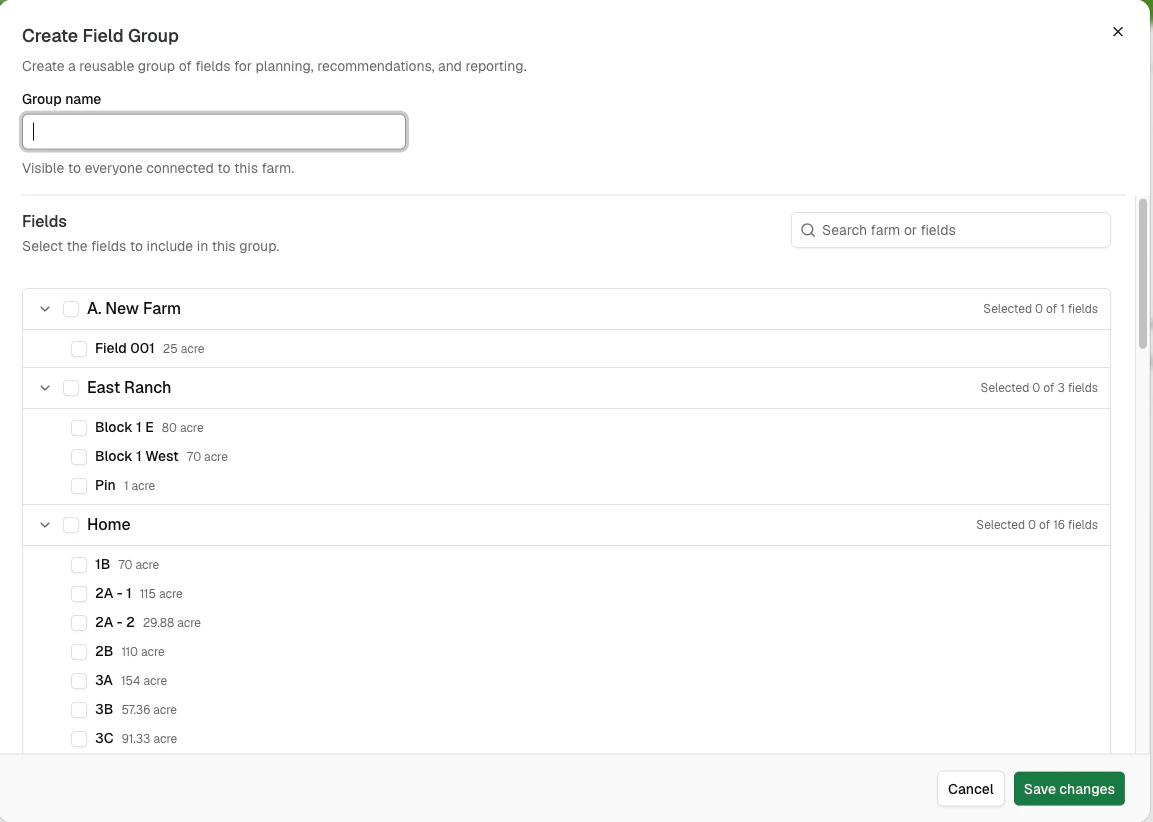
Every farming operation has its own way of organising fields. While farms provide the underlying structure in Agworld, there are plenty of situations where you might want to group fields in another way. Field Groups give you that flexibility. You can create groups of fields based on the way your business operates, without changing the underlying farm and field structure in Agworld.
Fields can be grouped by:
- Crop type or variety (B3XF, Clearfield)
- Agronomist
- Irrigation type
- Management type or zone (e.g. conventional vs organic)
- Any other characteristics that are important to your operation
For agronomy and retail businesses, Field Groups could also be used to organise fields according to internal workflows or responsibilities.
Field Groups can be configured from the redesigned Company Settings page, which also includes additional authorship information so you can see who created each group.
We’ve deliberately made Field Groups collaborative. While each group has an author, anyone who can see a Field Group can also edit it. This allows teams to maintain useful groupings together rather than making them dependent on one individual.
This feature is now available to Agronomist Plus and Pro subscriptions, as well as Grower Plus, Pro and Enterprise subscriptions.
See ‘days since planting’ at a glance
We’ve also made a small but valuable improvement to the Agronomic Snapshot on web and mobile.
Whenever a field has a planting date in the past, Agworld will now automatically show the time since planting within the Agronomic Snapshot. For crops planted within the past 365 days, this is displayed as the number of days since planting. When the planting date is more than 365 days ago, Agworld displays the elapsed time in years instead.
That means there’s no need to find the original planting date and calculate crop age yourself when you need a quick reference. The information is available alongside the other agronomic details in the snapshot, whether you’re reviewing a field from the office or accessing Agworld on mobile.
We’ve also cleaned up the font and placement of information within the Agronomic Snapshot to make it clearer and easier to read.
More useful information, organised your way
If you have any questions about how you can access and leverage these two updates in your organisation, please don’t hesitate to give us a call!
If you have any questions about how you can access and leverage these two updates in your organisation, please don’t hesitate to give us a call!