
Problem
Serving 10 to 15 growers per advisor, plus a larger base of smaller operations spread across Oregon’s Willamette Valley, Pratum Co-op’s agronomy, drone, and application teams had no shared way to move a recommendation from a crop advisor’s notebook into an applicator’s hands, confirm exactly what was sprayed and when, and bill a grower for the precise amount of chemical actually used.
Solution
Pratum Co-op now runs its entire service chain through Agworld: crop advisors scout fields and write recommendations, the ag services team schedules and assigns work orders to drone and ground applicators, and applicators convert each job into a timestamped actual with exact chemical volumes, acres covered, and weather conditions; all routed automatically to the people who need it, from advisors to billing to the grower.
Result
Growers get a spray record they can hand straight to a buyer or inspector and Pratum bills down to the ounce instead of the drum. Crop advisor Matthew Mehlschau says the real payoff is what Agworld gives back to everyone involved: time. “There’s only two things in this world that are non-renewable resources, and that’s land and time,” he says. “Agworld really helps streamline and maximise the use of both for growers and for myself as a crop advisor.”
A co-op built on what growers need
Pratum Co-op was founded in 1948 by a group of local grass seed farmers who wanted a better way to market their crop. “Since then, the business has naturally fulfilled the different needs that our customer base has,” says Lane Marsh, the co-op’s ag services technology lead. The Ag Services division grew the same way, in response to two problems most Willamette Valley growers share: labor shortages and the cost of specialised equipment. Today that division runs drone spraying, lime application, potash banding, soil moisture probes, and NDVI mapping alongside the co-op’s core agronomy and retail business.
Matthew Mehlschau is one of the co-op’s crop advisors, working out of its Millersburg branch across grass seed, specialty seed crops, hazelnuts, and mint. He’s been with Pratum for eight years, and his growers buy their chemicals and fertiliser through the co-op as part of the advice relationship. “There are certain growers that just want recommendations from me,” he says. “There’s other ones that really enjoy the scouting side of things, soil sampling; it’s all tailored to the specific grower.”
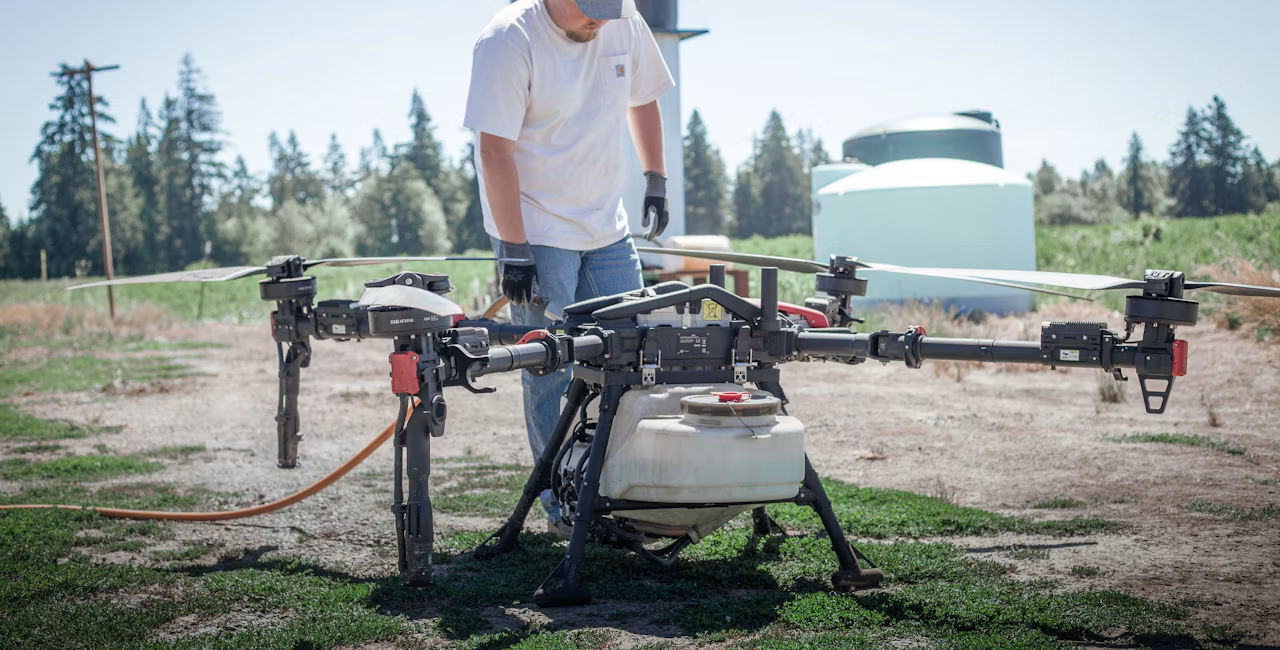
The drone program Lane oversees exists for the same reason the co-op does: to solve a problem growers can’t easily solve alone. “There’s no need to buy specialised application equipment if you choose to do drone work,” he says, pointing to hazelnut orchards, where a large ground rig with 75-foot booms simply doesn’t fit. Blueberries are an even clearer case: Pratum’s drones fly roughly 25 miles an hour and cover about 30 acres an hour, fast enough to hit tight pre-harvest-interval windows while avoiding the fruit loss a ground rig’s pass can cause. “If farmers can cooperatively come together and we own this as a co-op and we provide this service to our owners, it’s a win-win-win for everybody,” Lane says.
From recommendation to work order to actual
Matthew’s day starts with Agworld’s scouting and soil-sampling tools, checking traps for filbert worm counts, scouting fields, or pulling grid soil samples, and turning these records into a recommendation all within the Agworld platform. Agworld’s tank-mix feature carries that precision through to the field: “Being able to change your size of tank and have it spit out the exact amounts of different products that you need is very helpful. When you calculate things manually, all it takes is one person to slip up, and suddenly you’re getting a call asking if they can still spray,” he says.
Those recommendations become Lane’s work orders. “Work orders or recommendations are created by our certified crop advisors. From there, those jobs that have to be taken care of by the co-op’s application team are all assigned to me in Agworld. I then create the schedule for the day or week and assign each job to the applicator that will be in that field,” he says. For drone jobs specifically, Agworld and the drone’s own software share data on how many acres remain within a field in real time, which helps the team batch the next chemical load correctly.
Drone applicator Alec Avery sees the other end of that same work order. “I can pull up Agworld, and it shows me every field that’s on our recommendation of what we need to spray with fields highlighted, blocks broken out, rates and chemicals already listed.” “I only see the jobs that are assigned to me, which keeps it clean and simple.” He uses Agworld’s tank-mix calculator daily: “It’s never came out wrong as far as your mixing rate, what chemical you’re using, etc.” Once a job is done, Alec converts it into an actual with mapped acres and total chemical used, the same step Lane depends on for accurate billing. “Agworld has really given us the ability to eliminate a lot of manual steps and send that actual to the appropriate field staff who need it for customer records or blueberry compliance standards, as well as take that same actual and forward it to our billing department,” Lane says. “Because those fixed amounts are on the Agworld spray record, they can accurately bill down to the ounce how much chemical we used for that field.”
Records a grower can hand straight to a buyer
Every spray record in Agworld carries weather data: start time, end time, and wind conditions, alongside the details of the application itself, and Lane passes that record straight to the grower. “They can even take the next step and pass that on to a crop inspector for potential market use,” Lane says. Alec sees the same value from the field. A growing number of Pratum’s growers have their own Agworld account now, so they can see exactly what was applied, where, and when. This is especially useful during blueberry harvest, when knowing the re-entry and pre-harvest-interval timing matters as much to the grower as it does to Pratum.
A tool that growers adopt quickly Matthew says growers can be hesitant when they first start using Agworld, simply because it’s unfamiliar, but that changes fast. “Within the first month they are extremely happy with Agworld,” he says, especially growers working with interval-sensitive crops like garlic or hazelnuts, where seeing the exact date and temperature a fungicide was applied explains why control was or wasn’t effective. The alternative, he says, is a paper recommendation that’s “inevitably lost or eaten by the dog,” followed by a Friday-evening phone call trying to remember what the rate was supposed to be. A mistake on that scale isn’t hypothetical: double the rate of insecticide on a field accidentally and suddenly the crop can’t be sold at all. Some growers also use Agworld’s planning feature to lay out a full season instead of an Excel sheet, and financially track everything to watch cost per acre in an industry where, as Matthew puts it, margins keep shrinking.
For Lane, the clearest value of all of it comes back to trust. “With Agworld I confidently know that my applicators are in the field creating their spray logs and tracking all important information,” he says. “I don’t have to look for a piece of paper at the end of the day. I can find every job on demand, and I have a whole base of that information archived within Agworld. If there’s any questions asked, I can definitively say, yes, this is what happened. It’s all timestamped out perfectly.” What started as a way to get a recommendation out of an advisor’s notebook has become the record the whole co-op — and its growers — runs on.
As Matthew summarises Agworld: “There are only two things in this world that are truly non-renewable resources, and those are land and time. Agworld helps streamline and maximise the use of both land and time for growers, as well as myself as a crop advisor.”
