Problem
As M G Farming expanded its arable cropping operation across a wider geographic footprint, keeping track of plans, inputs, and field work became increasingly complex. What had once been manageable through memory, calendars, and other 1-on-1 communication, could no longer be scaled with the business. Numerous crop types, several agronomists, and a growing team meant that important details could easily be missed. Without a consistent system, there was a real risk of introducing errors and losing information.
Solution
M G Farming adopted Agworld as its farm management system, embedding it into daily operations as the business grew. Plans, budgets, recommendations, work orders, and record keeping is now all taken care of on the same platform, creating a clear workflow from planning through to execution. Agworld has become the system that connects everyone on the farm, ensuring that everyone involved in the farming process works from the same source of information. Instead of relying on memory or conversations that might be forgotten, every decision and action is logged on Agworld.
Result
Agworld now underpins M G Farming’s ability to operate at scale with confidence.
- Improved team coordination and fewer mistakes with clear visibility into what needs to be done and when.
- Better, faster decision-making with easy access to structured operational data.
- More accurate financial forecasting and reporting with planning and budgeting aligned to what’s actually happening in the field.
A multi-generation business built for growth
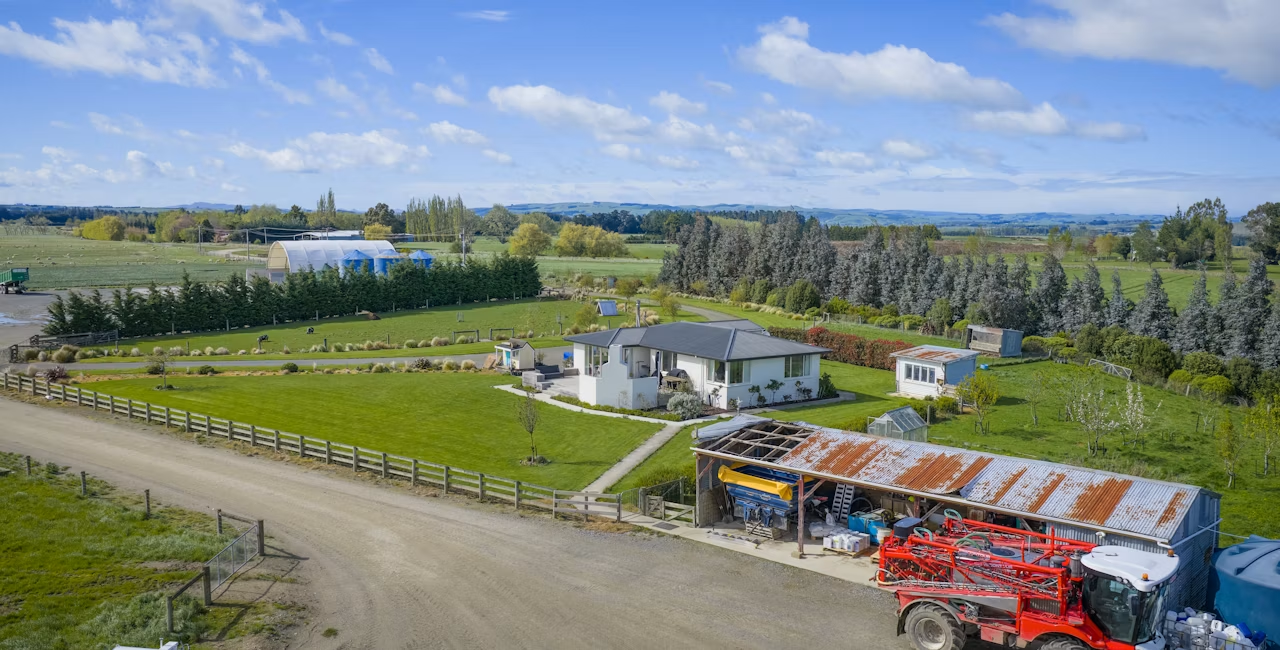
M G Farming is based at Chatton, just north of Gore in Southland, operating as a large, modern farming business with deep family roots. Owner Michael Gardyne is a fifth generation farmer who, together with his wife Marie-Louise, has grown the business significantly over the past decade. “We’ve grown our farming operation from just the family’s property that we started with, and now lease properties around the area over a 40 kilometre spread,” Michael says, “That’s grown our business to 1400 hectares of arable land.”
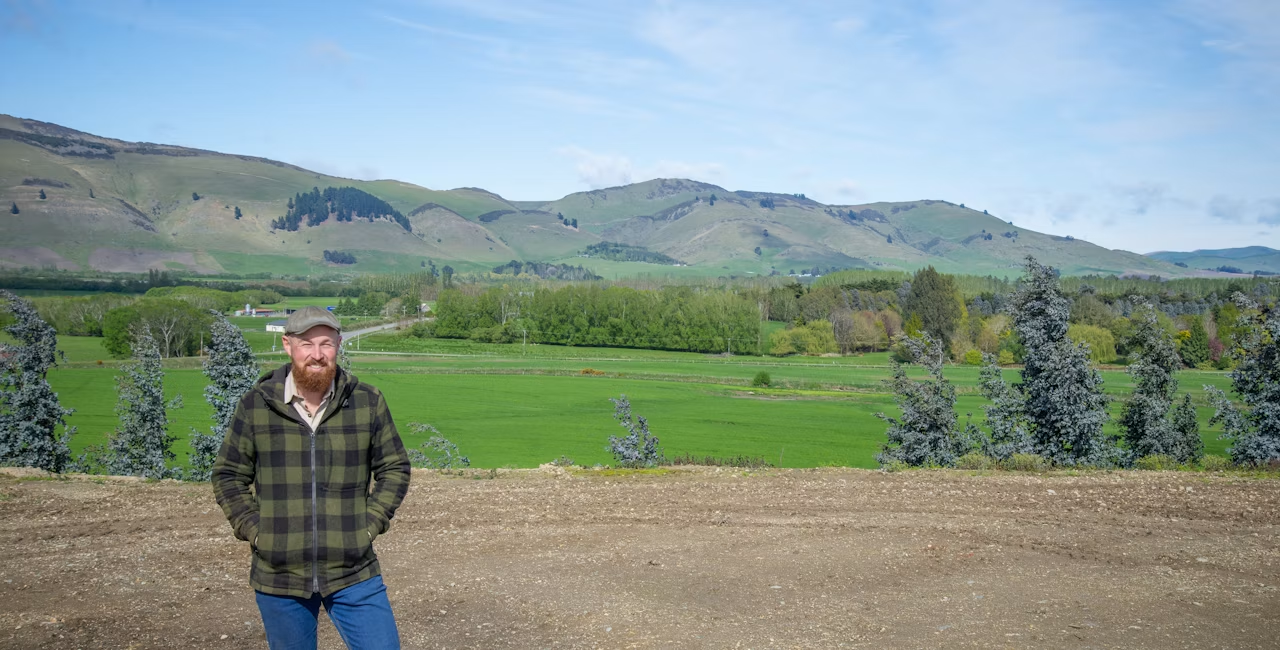
The business focuses primarily on feed grain crops for the dairy industry, sold through his brother’s business - Gardnye’s Grain, alongside milling oats supplied to Harraway’s in Dunedin and a range of seed crops. Livestock grazing is also integrated into the system through the use of grazing crops with store lambs.
As the scale and complexity of the operation increased, so did the need for better systems. In the early years, managing cropping operations without formal systems was possible. But Michael quickly realised that approach wouldn’t hold up as the business grew. Michael: “Early on it was easy enough to keep stuff in your head,” he says. “But I worked out pretty quickly that it wasn’t going to work if we kept growing.”
Choosing Agworld
The challenge for Michael wasn’t just the number of hectares. It was the overlap of activities: multiple cropping seasons running at once, harvest occurring alongside sowing, grazing operations happening in parallel, and increasing staff involvement. “What seems like it could be quite complicated is no problem in Agworld,” Michael says, because the system provides him a way to manage that complexity.
“It’s been the first program we actually have used properly and we have been consistent with it at recording data,” Michael explains. “Which has been a big help, especially as we’ve grown in size.” One of the key reasons Agworld stood out early was its integration with financial systems. “A big draw card was the integration with Figured because we use Figured and Xero,” Michael says. “Once I looked into it, it seemed fairly obvious to me that it was a good choice. And right now, Agworld is a very critical part of our operations, especially with having a full-time farm manager.”
Clear workflows, fewer mistakes
At M G Farming, Agworld provides a clear operational structure. Planning starts at the beginning of the season, with crop plans created and applied across the farm. “We use the planning as well, so we’ll create those season plans,” Michael explains. “That’s helped us with budgeting, forecasting financially, and then also for chemical orders. We then convert these plans into work orders as the season progresses, adapting them based on changing dates, rates and products as required.”
At M G Farming, the team knows that the system only works because it’s used 100% of the time, explains Michael: “Unless it’s a work order, they don’t touch it, so they’re not going to do anything off a plan. Once it’s a work order then it’s fair game, the guys know that work orders are there and they can execute on them.” That clarity has reduced errors and removed ambiguity for staff. Operators don’t need to interpret instructions or rely on memory; they simply follow what’s in the system.
Before Agworld, looking back at what had happened in a field was time-consuming and unreliable. “I had to go through texts and look at the calendar to try and work out what happened and what we were doing that day,” Michael recalls, “Now it’s great, you just jump onto Agworld and go, ‘yep’, that’s when it happened, and that was the rate that went on.”
Linking operations to financial reality
One of the most powerful aspects of Agworld for M G Farming is how operational data feeds directly into financial planning. “We keep the costing of all the chemical and fertiliser inputs updated in Agworld, and that feeds through for creating the cashflow budget for getting seasonal finance,” says Michael. “Because the crop data is already built and maintained in Agworld, financial planning becomes far simpler; I don’t have to go right back into the nitty gritty of that crop data, the farm manager has already done that and then it’s just there feeding into the budget. That’s been a big shift for us, being able to give good cashflow budgets to funding partners.”
M G Farming also uses Agworld for post-season analysis, even if that review isn’t always formal. “We try to keep the individual field data as accurate as we can in Agworld, so we can go back through and see the gross margins for different fields. That data supports future planning and helps guide decisions about fertiliser, chemical use, and crop selection. It’s comforting knowing we have that data there for when we need it and it won’t take much time at all to gather all this information; for when we need to supply it to a third party for compliance reasons for example. Instead of that process costing us a lot of time and effort, it’s now easy to get these third parties what they need quickly. ”
A system that enables growth
When asked what he would say to another farmer considering Agworld, Michael’s response is straightforward. “I can give many reasons,” Michael says, “but the main one is that it works. Agworld doesn’t cause us issues or extra work, instead it makes life easy, especially for working with staff and remembering exact details.”
Michael finishes with; “Agworld has been a big part of us being able to grow our business. When we want to take on another cropping property, that’s never an issue. Just add it into Agworld, create some plans, and away we go.
